

← Back to Insights

How Elevare Works: From Organisational Moment to Lasting Impact

    When organisations bring Elevare in, it is rarely for a single, isolated issue. More often, it is during a moment that matters — scaling, integration, restructuring, or a broader transformation where leaders sense that something more fundamental needs alignment.
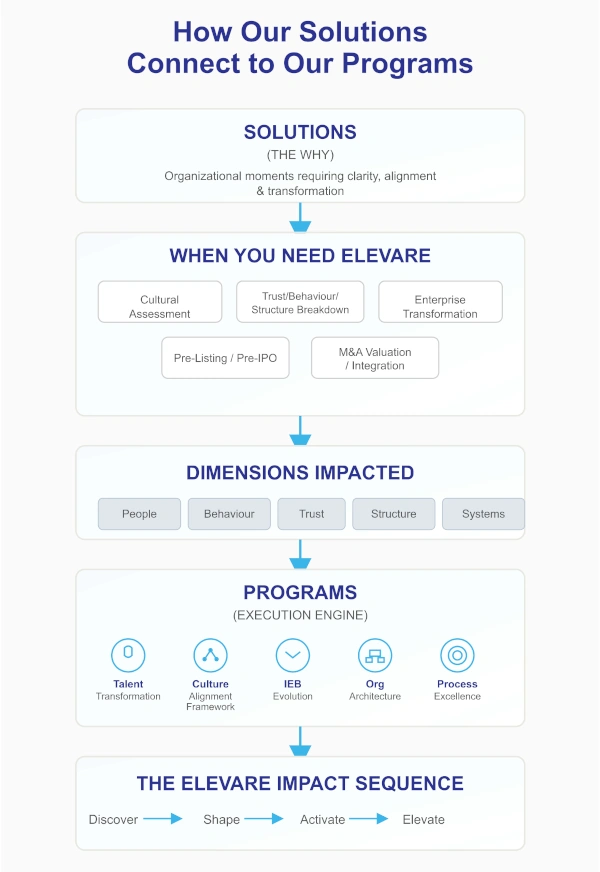
    The diagram below captures how Elevare partners with organisations through these moments and how clarity turns into action.

    Starting with the Organisational Moment

    Every engagement begins with the context — not the solution.
    Organisations typically reach out during periods of complexity: growth that is outpacing structure, post-merger integration, leadership transitions, operating model change, or increasing pressure on performance. These moments often surface as cultural challenges, talent concerns, process inefficiencies, or trust issues — but they are rarely confined to just one area.

    Rather than treating these as standalone problems, Elevare frames them as organisational moments that require clarity, alignment, and deliberate design.
    Understanding the Dimensions Being Impacted

    Once the context is clear, the focus shifts to understanding what is really being affected inside the organisation.

    Across engagements, five dimensions consistently come into play:

    • People – capability, engagement, leadership readiness
    • Behaviour – how decisions are made, how work actually happens
    • Trust – confidence in leadership, systems, and each other
    • Structure – roles, accountability, operating models
    • Systems – processes, governance, performance mechanisms

    Not every situation impacts all five equally. The purpose of this step is to identify where change is actually needed, rather than applying broad solutions by default.

    Activating the Right Interventions

    Based on this understanding, Elevare activates the relevant programs — and only those that are required.

    Whether the focus is Culture, Talent, DEI, Organisation Design, or Process improvement, Elevare’s methodology adapts to the organisation’s needs. Not every client needs everything. In fact, targeting the right dimensions is what prevents change fatigue and accelerates progress.

    Where multiple dimensions are involved, the emphasis is on integration. Talent initiatives are aligned with structure. Cultural aspirations are reinforced through systems. Process improvements are designed to support desired behaviours. This ensures the organisation functions as a connected system, not a set of parallel initiatives.

    How Change Moves from Insight to Impact

    All work is delivered through the Elevare Impact Sequence — a four-stage methodology that ensures change is not only designed, but embedded.

    Discover

    Build a clear, multi-dimensional understanding of the organisation

    Shape

    Design aligned solutions across people, culture, structure, and system

    Activate

    Enable leaders and teams to adopt new ways of working

    Elevate

    Reinforce progress so change becomes practice

    This sequence ensures Elevare is not a diagnostic-only partner. It supports leaders through implementation and reinforcement, helping organisations move from clarity to confidence.

    What Leaders Gain

    The outcome of this approach is twofold.

    First, leaders gain clarity — a grounded understanding of how the organisation truly functions, beyond surface symptoms.

    Second, they gain a practical blueprint that connects people, culture, systems, and processes. This blueprint supports decision-making, reinforces leadership behaviour, and enables sustained performance over time.

    When change is targeted, integrated, and reinforced, it stops feeling like a project. It becomes part of how the organisation works.

    This is what Elevare is designed to deliver.


    ← Back to Insights

    How Elevare Works: From Organisational Moment to Lasting Impact

      When organisations bring Elevare in, it is rarely for a single, isolated issue. More often, it is during a moment that matters — scaling, integration, restructuring, or a broader transformation where leaders sense that something more fundamental needs alignment.
      The diagram below captures how Elevare partners with organisations through these moments and how clarity turns into action.

      Starting with the Organisational Moment

      Every engagement begins with the context — not the solution.
      Organisations typically reach out during periods of complexity: growth that is outpacing structure, post-merger integration, leadership transitions, operating model change, or increasing pressure on performance. These moments often surface as cultural challenges, talent concerns, process inefficiencies, or trust issues — but they are rarely confined to just one area.

      Rather than treating these as standalone problems, Elevare frames them as organisational moments that require clarity, alignment, and deliberate design.

      Understanding the Dimensions Being Impacted

      Once the context is clear, the focus shifts to understanding what is really being affected inside the organisation.

      Across engagements, five dimensions consistently come into play:

      • People – capability, engagement, leadership readiness
      • Behaviour – how decisions are made, how work actually happens
      • Trust – confidence in leadership, systems, and each other
      • Structure – roles, accountability, operating models
      • Systems – processes, governance, performance mechanisms

      Not every situation impacts all five equally. The purpose of this step is to identify where change is actually needed, rather than applying broad solutions by default.

      Activating the Right Interventions

      Based on this understanding, Elevare activates the relevant programs — and only those that are required.

      Whether the focus is Culture, Talent, DEI, Organisation Design, or Process improvement, Elevare’s methodology adapts to the organisation’s needs. Not every client needs everything. In fact, targeting the right dimensions is what prevents change fatigue and accelerates progress.

      Where multiple dimensions are involved, the emphasis is on integration. Talent initiatives are aligned with structure. Cultural aspirations are reinforced through systems. Process improvements are designed to support desired behaviours. This ensures the organisation functions as a connected system, not a set of parallel initiatives.

      How Change Moves from Insight to Impact

      All work is delivered through the Elevare Impact Sequence — a four-stage methodology that ensures change is not only designed, but embedded.

      Discover

      Build a clear, multi-dimensional understanding of the organisation

      Shape

      Design aligned solutions across people, culture, structure, and system

      Activate

      Enable leaders and teams to adopt new ways of working

      Elevate

      Reinforce progress so change becomes practice

      This sequence ensures Elevare is not a diagnostic-only partner. It supports leaders through implementation and reinforcement, helping organisations move from clarity to confidence.

      What Leaders Gain

      The outcome of this approach is twofold.

      First, leaders gain clarity — a grounded understanding of how the organisation truly functions, beyond surface symptoms.

      Second, they gain a practical blueprint that connects people, culture, systems, and processes. This blueprint supports decision-making, reinforces leadership behaviour, and enables sustained performance over time.

      When change is targeted, integrated, and reinforced, it stops feeling like a project. It becomes part of how the organisation works.

      This is what Elevare is designed to deliver.


      • Embedding Performance Culture in a Scaling Firm

        A high-growth analytics and KPO firm was entering a phase of growth-led professionalisation. What had begun as an entrepreneurial, founder-driven…

      • Human Due Diligence in a Cross-Border Travel & Events Alliance

        An India-based, family-owned travel and tour operator with deep destination expertise entered into a formal alliance with the Indian arm…

      • People-First Is Not Soft — It Is Operational Discipline

        “People-first” is often misunderstood as prioritising comfort over performance. In practice, the opposite is true.